


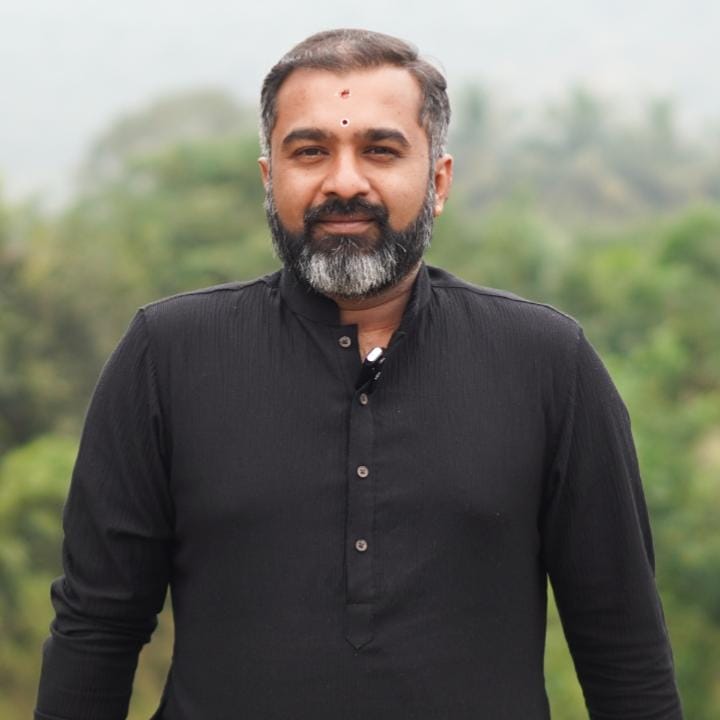
Yogacharya Aravind Prasad is an internationally accredited yoga mentor recognized for integrating India’s classical spiritual sciences into a structured pathway for contemporary practitioners. Rooted in the spiritual landscape of Pondicherry, his early life was marked by what he describes as a defining blessing from a revered yogi, who affirmed the deeper meaning of his name, “Prasad,” signifying a sacred offering. That formative moment shaped his life’s direction toward service through knowledge.
Raised in a family where spirituality was deeply embedded in daily life, his foundational learning emerged from oral traditions rather than conventional schooling. Stories of the Puranas and Vedanta, shared in intimate home settings, cultivated a profound curiosity about consciousness and human potential. Choosing an unconventional path, he stepped away from mainstream education to undertake a six-year residential Gurukulam training. There, he immersed himself in Vedanta, Yoga, and Tantra—not as isolated doctrines, but as interconnected systems of inner development.
This traditional grounding was later complemented by formal academic achievement. He earned a Master’s degree in Yogic Science and engaged in research exploring the neurophysiological effects of the Gayatri Mantra, contributing to dialogue between ancient spiritual practices and contemporary scientific inquiry. His work reflects an ongoing effort to bridge experiential wisdom with evidence-based understanding.
Between 2009 and 2012, he expanded his teaching internationally, engaging diverse audiences across cultures. Exposure to global seekers refined his perspective. He observed that while information about wellness was widely available, many individuals lacked an integrated framework to apply it meaningfully. Techniques were abundant, yet coherence was missing. This insight became the catalyst for a more unified approach to yogic education.
In Mysore, he founded Samyut Yoga, a center dedicated to what he terms Scientific and Mystical Yoga for Universal Transformation. The word “Samyut,” meaning well unified or integrated, reflects his guiding philosophy. Within this framework, Vedanta offers philosophical clarity, Tantra provides psychological tools, and Raja Yoga supplies a disciplined experiential path. Rather than treating yoga as a series of physical postures, he positions it as a comprehensive science of inner alignment aimed at cultivating health, clarity, and emotional balance.
As a mentor, he has guided more than 2,000 practitioners from over 80 countries. His programs emphasize immersive, small-group learning environments inspired by the traditional Gurukulam model, adapted for modern contexts. By prioritizing depth over scale, he seeks to facilitate sustainable transformation rather than transactional certification. Students often describe his methodology as both rigorous and reflective, encouraging introspection alongside disciplined practice.
His own journey has included personal trials, setbacks, and moments of rejection. He speaks openly about these experiences as catalysts for humility and resilience. His advice to aspirants remains consistent: become a sincere student before aspiring to teach, and embody wisdom before attempting to share it. This philosophy underscores his belief that authenticity is the cornerstone of meaningful instruction.
His work has received attention from national and international media platforms, including Doordarshan and India Today, among others. He has also been recognized with awards acknowledging his contributions to yoga education and holistic well-being.
Today, he continues to position himself as a bridge between ancient spiritual traditions and the analytical mindset of the modern world. By integrating classical teachings with contemporary relevance, he invites collaborative efforts to promote a vision of unified living—where health, happiness, and harmony are cultivated through disciplined understanding rather than fragmented practice.
************************